
The modern academic landscape has shifted from the quiet corners of physical libraries to a high-speed digital ecosystem. For today’s undergraduate, the challenge isn’t just finding information—it’s managing the sheer volume of it. When you are staring down a massive term project or a capstone thesis, the traditional “sit and type” method often leads to burnout long before you hit your word count goals. Success in contemporary higher education requires a transition from being just a writer to becoming an architect of information.
Architecting a paper means building a structural framework that supports complex arguments. This involves selecting a “tech stack” that handles the heavy lifting of organization, citation, and formatting, allowing your brain to focus on critical analysis. By treating a long-form assignment like a construction project—complete with blueprints, foundations, and scaffolding—you can produce high-level academic work without the last-minute panic that usually accompanies large submissions.
The foundation of any massive project is understanding the specific constraints of the prompt. For instance, when you are tasked with a comprehensive research project, knowing the structural nuances of how to write a 5000 word essay is critical for maintaining a coherent argument from start to finish. Without this structural blueprint, a paper of that length can easily become a collection of disjointed thoughts rather than a unified thesis. Professionals at Myassignmenthelp often suggest that the “pre-writing” phase—where you map out your word counts per section—is actually more important than the writing phase itself.
The Digital Architect’s Toolbox
To survive a rigorous semester, you need tools that talk to each other. “Digital Debt” occurs when your notes are in one app, your citations are in a Word doc, and your PDFs are scattered across your downloads folder. To rank among the top students in your cohort, you must centralize your workflow.
| Tool Category | Recommended Apps | Primary Benefit |
| Knowledge Management | Notion, Obsidian | Visualizes connections between different research papers. |
| Reference Management | Zotero, Mendeley | Automates bibliography creation and stores PDF annotations. |
| Focus & Discipline | Forest, Cold Turkey | Blocks distracting sites to ensure “Deep Work” sessions. |
| Writing & Editing | Scrivener, Hemmingway | Helps manage long-form drafts in manageable “chunks.” |
Mastering the “Sprinting” Technique
Most students fail at long papers because they try to write the entire document in one or two marathon sessions. This is the fastest way to trigger writer’s block. Instead, use the “Modular Writing” approach. This involves breaking the paper into 500-word modules. If you write one module a day, a massive assignment is finished in ten days with minimal stress.
During these modules, focus entirely on the “messy draft.” Do not edit for grammar or flow while you are generating ideas. The goal is to get the “architectural” bones of the argument onto the page. If you find yourself stuck on a specific transition or struggling to find the right phrasing to start a section, utilizing a digital resource like an essay typer can be a practical way to jumpstart your creative engine. This helps you visualize different sentence structures and move past the “blank page syndrome” that often halts progress on complex assignments. By integrating such tools into your workflow, you can maintain your momentum and ensure that your Myassignmenthelp strategies are focused on the actual analysis rather than just struggling with the introductory sentences.
Navigating the Research Labyrinth
Research is no longer about finding “enough” sources; it’s about finding the right sources. Global academic standards now prioritize “synthesis” over “summary.” This means your paper shouldn’t just say “Author A says X.” It should say “Author A says X, which contradicts Author B’s finding of Y, suggesting a gap in the current understanding of Z.”
To achieve this level of sophistication, use academic databases like JSTOR or Google Scholar effectively. Set up “Alerts” for your topic so that new research is delivered to your inbox. As you read, use a digital highlighter to tag themes. When it comes time to write, you won’t be re-reading papers; you’ll be looking at a curated list of themes that you’ve already identified. This is the difference between a student who is “just getting by” and one who is mastering their field.
The Importance of “Deep Work”
In an era of constant notifications, the ability to focus for two hours straight is a superpower. Cal Newport, a leading voice on productivity, calls this “Deep Work.” For a student, this means turning off your phone, closing unrelated tabs, and entering a flow state.
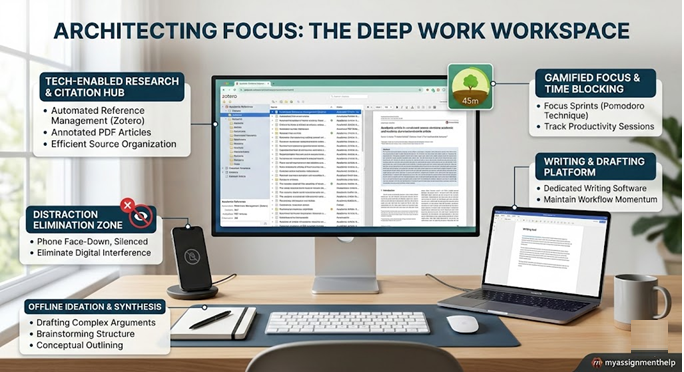
High-word-count papers require a level of cognitive depth that cannot be reached in 15-minute bursts between scrolling through social media. Schedule your deep work sessions during your peak biological hours—whether that’s 6:00 AM or 10:00 PM—and guard that time fiercely.
Final Refinement and Global Standards
Once the draft is complete, the “polishing” phase begins. This is where you transition from an architect to an editor. Global academic tones require objectivity and precision. Avoid “filler” words like “very,” “really,” or “basically.” Instead, use strong verbs and precise nouns.
Frequently Asked Questions (FAQ)
1. How many pages is a 5,000-word essay usually?
The page count largely depends on your formatting. For a standard academic paper using double-spacing and 12-point font, 5,000 words typically span about 18 to 20 pages. If you are using single-spacing, it will likely be around 9 to 10 pages.
2. What is the best way to structure a high-word-count research paper?
A long-form paper requires a robust “word budget” to ensure you don’t run out of material or repeat yourself. A common blueprint for a 5,000-word project includes an Introduction (500 words), a Literature Review (1,000 words), Methodology (500 words), the Main Analysis/Body (2,500 words), and a Conclusion (500 words).
3. How can I stay focused when working on assignments that take multiple days?
Focus is best maintained through “time-blocking” and the Pomodoro Technique—working for 25 minutes followed by a 5-minute break. Using focus apps like Forest or Cold Turkey can prevent you from drifting toward social media.
4. Is it helpful to use digital writing aids during the drafting phase?
Yes, digital aids are excellent for overcoming “blank page syndrome.” Tools like an essay typer or brainstorming software can help you visualize different sentence structures and jumpstart your creativity when you feel stuck on a particular section.
5. How do I avoid “Red Flags” like accidental plagiarism in long papers?
The most effective way to avoid plagiarism is to use reference management software like Zotero or Mendeley from the very first day of your research. Never copy and paste text into your draft with the intention of “changing it later.” Instead, read the source, close the tab, and write the idea in your own words.
About the Author
I am Ethan Martin, an educational consultant and career strategist dedicated to helping students navigate the complexities of modern higher education. With a professional background centered on academic workflow optimization, I specialize in bridging the gap between traditional research methods and the latest digital productivity tools.